


Bringing a loved one home after a serious illness can feel reassuring and daunting at the same time. If they still need close observation, complex nursing, or prescribed medical equipment, you may be considering ICU care at home.
The starting point is an individual assessment by the treating medical team. A home care arrangement must meet the patient’s actual needs, with clear responsibilities and a plan for getting urgent hospital help. This guide explains what Pakistani families should discuss before arranging that transition.
If someone is already seriously unwell or suddenly deteriorating, seek emergency medical help. Arranging home nursing must not delay urgent treatment.
What Does ICU Care at Home Mean?
ICU care at home is a term used for higher-dependency nursing and medical support delivered in a residence. Depending on the person, it may involve close observation, prescribed treatment, help with daily care and specialised equipment.
It does not mean that a bedroom has all the facilities of a hospital intensive care unit. A monitor can display observations; it cannot replace immediate access to a hospital’s emergency team, investigations and procedures.
| Care setting | Main purpose | Important limit |
|---|---|---|
| Routine home nursing | Planned nursing visits or ongoing support for defined care needs. | A routine visit is not continuous observation or emergency cover. |
| Higher-dependency home care | More intensive support for a person assessed as suitable for the proposed home arrangement. | Staffing, devices and clinical oversight must be agreed for that individual. |
| Hospital ICU | Hospital-based intensive monitoring and treatment for patients who need its resources. | Some patients cannot safely receive their required treatment at home. |
Who May Be Considered for Care at Home?
Some patients recovering from critical illness, major surgery or a prolonged hospital stay may be considered for home care. The diagnosis alone does not establish suitability: two people recovering from the same illness can need very different levels of support.
The treating team should assess medical stability, current treatment, how quickly help may be needed and whether the proposed home setup can meet those requirements. For someone recovering after surgery, the discussion may include whether post-operative care at home is sufficient or more intensive support is needed.
Prescribed oxygen, a tracheostomy or long-term ventilation requires a specific assessment. A tracheostomy is an opening in the neck into the windpipe; supporting someone with this airway requires appropriate skills and an individual plan. A device or condition should never be treated as automatic approval for home care.
Hospital care remains necessary when the patient needs treatment, monitoring or rapid intervention that cannot safely be delivered at home. Family preference, bed availability and a provider’s advertised equipment list cannot establish clinical suitability.
Where possible, involve the patient in the decision and explain the proposed arrangement in language they understand. Discuss their preferences, consent and who is authorised to receive updates.
Who Is Responsible for Each Part of Care?
Ask for named contacts and a written allocation of responsibilities. Understanding the role of critical care nurses can help families distinguish skilled nursing from personal care or companionship.
| Person or team | What to clarify |
|---|---|
| Treating clinician | Who sets the treatment plan, reviews progress and authorises clinical changes? |
| Nursing provider | Who checks staff competency, supervises care and arranges cover for absences? |
| Bedside nurse | Which prescribed tasks, observations, records and escalation responsibilities are assigned? |
| Equipment supplier | Who installs, services and replaces devices, and answers fault calls? |
| Family contact | Who coordinates practical arrangements, receives updates and keeps essential documents accessible? |
“24-hour care” needs a precise explanation. Confirm the number of staff, shift length, rest and relief arrangements, and what happens if a nurse cannot attend. Continuous cover should have a workable roster rather than depend on one person remaining awake indefinitely.
At handover, incoming staff should receive current instructions, recent observations, medicines already given and unresolved concerns. Family members should know whom to contact without becoming the only link between shifts.

What Must Be Ready Before Hospital Discharge?
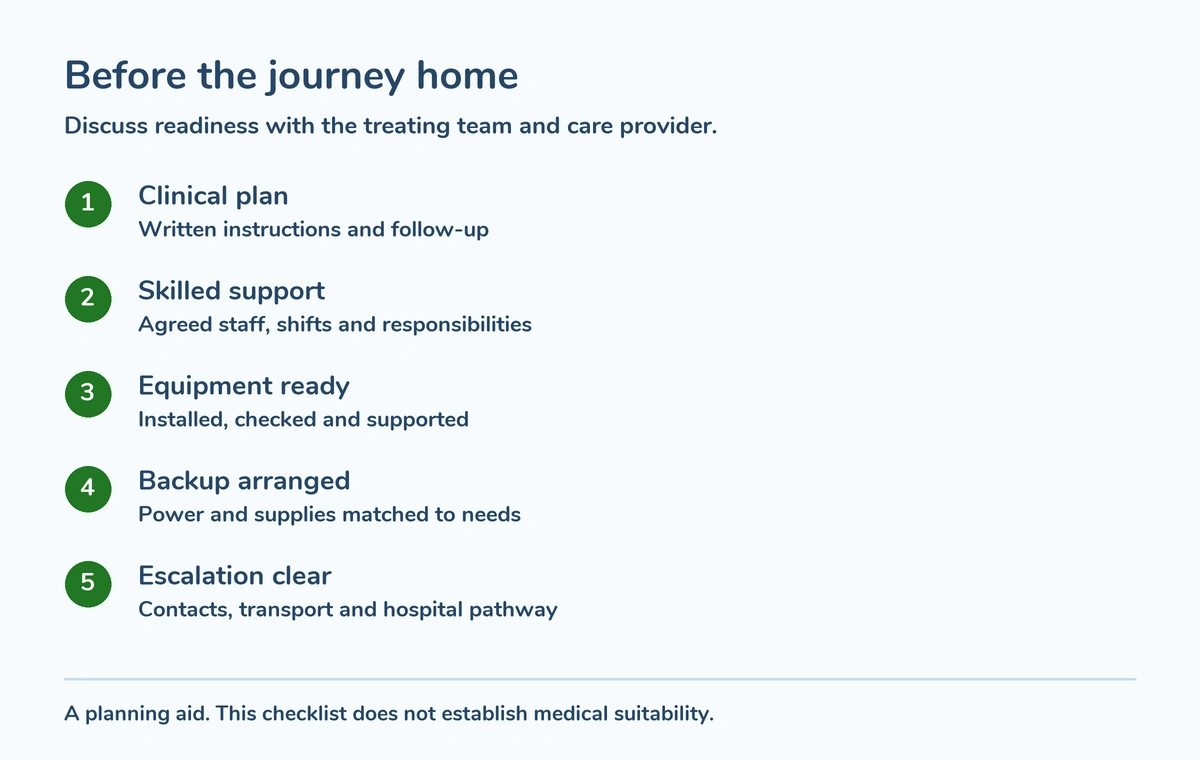
Use discharge planning to identify gaps while the hospital and home care teams can still resolve them together. The following checklist supports that conversation; it is not a clearance test for taking a patient home.
The Written Care Plan and Handover
Keep an up-to-date discharge summary, prescriptions and an individual care plan available to the people providing care. Clarify any conflicting instructions before the transfer.
- Confirm which clinician is responsible for follow-up and when review is due.
- Record prescribed care tasks and who is competent and authorised to perform them.
- Confirm the observation schedule and patient-specific instructions for reporting changes.
- Agree the medicines supply, refill arrangements and who maintains the administration record.
- Document feeding, swallowing, mobility and skin-care needs where relevant.
- Arrange the transport, receiving staff and handover time before departure.
NHS discharge guidance similarly emphasises a plan identifying support, responsibilities, review arrangements and emergency contacts. Local services differ, but these are useful questions to raise with the hospital team in Pakistan.
Equipment, Supplies and Backup Arrangements
There is no universal shopping list for a home ICU. The clinical plan should determine whether the patient needs monitoring devices, a suitable bed, prescribed oxygen, suction equipment, feeding supplies or other devices.
Ask the supplier to assess the room, electrical connections and access for moving the patient. Confirm installation, training, maintenance and replacement arrangements. Supplies should have a named person responsible for checking stock and ordering replacements.
For electricity-dependent treatment, agree and test a device-compatible backup plan with the clinical team and supplier. Establish how long it can support the prescribed equipment and what action is required before that time runs out. Do not assume a household UPS can run every medical device.
How Should Families Prepare for Deterioration or Equipment Failure?
A written escalation plan explains what to do when the patient’s condition changes or essential equipment stops working. Keep it beside the care records, with contacts available to every shift and the main family contact.
The plan should identify patient-specific warning signs, the appropriate clinical contact, the local emergency service, suitable transport and the hospital-transfer pathway. Ask what happens outside normal working hours and if the first contact does not answer.
Severe breathing difficulty, new sudden confusion, or lips or skin becoming blue or grey are examples of symptoms needing emergency medical help. Follow the emergency plan immediately; do not wait for a routine visit or an online reply.
The American Thoracic Society’s preparedness guidance recommends planning for power loss, equipment problems and transport. For prescribed oxygen or ventilation, agree suitable backup arrangements with the treating team and supplier before discharge.
Families should receive instructions for their agreed role and demonstrate that they understand them. Do not improvise ventilator settings, oxygen changes or airway procedures. Those tasks require the patient’s prescribed plan and appropriate training.
What Does Day-to-Day Support Involve?
The daily routine should follow the patient’s care plan and balance clinical tasks with comfort, dignity and rest. Depending on assessed needs, support may involve:
- Recording observations and reporting changes as directed.
- Giving prescribed medicines within the assigned professional’s scope.
- Personal hygiene, appropriate positioning and skin observation.
- Following the agreed nutrition, hydration and swallowing plan.
- Supporting movement and rehabilitation within professional advice.
- Maintaining device hygiene and infection-prevention routines.
Family participation can include companionship, practical coordination and tasks they have been trained to perform. Relatives should not be expected to take on clinical procedures simply because they live in the home.
Recovery after critical illness can involve physical weakness, fatigue and emotional difficulties. Ask which rehabilitation professionals or follow-up services are appropriate rather than assuming bedside nursing addresses every recovery need.
Arrange reassessment when needs change. More support may be required if problems develop; as the patient improves, the treating team can advise whether a less intensive arrangement is appropriate. Avoid committing to an unchanged package without a review plan.
What Affects ICU Care at Home Costs in Pakistan?
The total depends on the required staff, hours, equipment, supplies and medical oversight. A basic nursing rate does not establish the cost of a complete higher-dependency arrangement.
Request an itemised written quotation covering:
- Staffing: professional category, hours, shift cover and any additional charges.
- Equipment: rental or purchase, delivery, installation, maintenance and deposits.
- Consumables: prescribed supplies, replacement frequency and who pays for them.
- Clinical input: consultations, reviews and any separately charged visits.
- Contingencies: backup equipment, transport and costs arising from changed needs.
- Terms: minimum duration, cancellation, refunds and excluded services.
Compare quotations against the same clinical requirements. Home care should not be presented as automatically cheaper than hospital care, and cost pressure should not determine whether an unsafe transfer proceeds.
What Should You Ask a Home Care Provider?
Before paying a deposit, ask the provider to confirm in writing:
- Can you meet this patient’s prescribed requirements, and which tasks are outside your service?
- Who will verify the assigned nurse’s credentials and experience with the required devices?
- Who is accountable for clinical supervision and unresolved concerns?
- What is the replacement plan for an absent nurse or failed device?
- Which services are included in the quote, and which must be arranged separately?
A provider should explain any limits before accepting the arrangement. If the proposed staff or resources cannot meet the treating team’s requirements, discuss an alternative care setting with the hospital.
Discussing Specialised Nursing Support With ConsidraCare
ConsidraCare Pakistan’s home nursing services include specialised ICU nursing. Families can share the discharge summary, prescribed care requirements, location and proposed start date to discuss the nursing support available.
Confirm the exact staffing, clinical oversight and any equipment-related arrangements for your relative. Do not assume that a nursing service includes a ventilator, all medical equipment or emergency transport. The treating team must assess suitability for home care, and the provider must confirm whether it can meet the proposed requirements.

Making an Informed Care Decision
A good home care decision begins with the patient’s needs and a realistic plan to meet them. Before discharge, make sure the treating team and provider have agreed the arrangement, essential support is ready, and everyone knows how to seek urgent help. Keep the plan under review as the patient’s condition changes.
This guide provides general information. Decisions about discharge, treatment and equipment must be made with the patient’s treating healthcare professionals.

